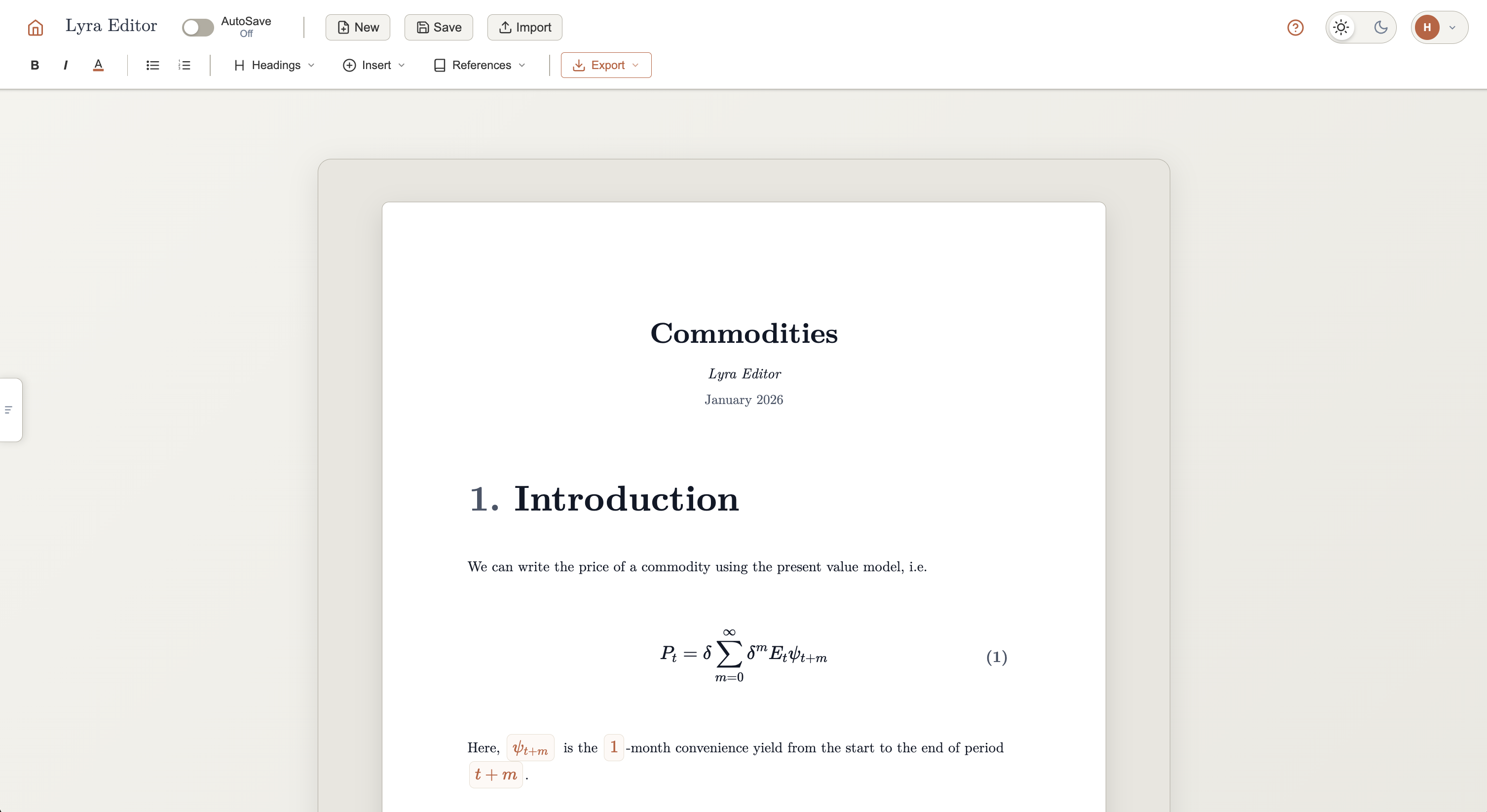
I've spent over a decade writing in LaTeX—through my BSc and MSc in Physics, my PhD in Economics & Finance, and years of teaching. I love LaTeX's typography. I hate editing it.
The moment I fell in love with LaTeX
First year of university, I walked into Calculus 1 and saw our professor's problem sets. They were beautiful—crisp equations, perfect spacing, professional typography. A year later, working in the computer lab, I discovered these weren't made in Word. They were written in something called LaTeX.
I tried it. I was hooked. The output quality was unmatched—still is, honestly.
The problem I couldn't ignore
Fast forward a few years. I'm working on longer documents—papers, my dissertation, lecture notes. The workflow starts to wear on me: edit code, compile, check PDF, spot the issue, dive back into the source. Even with live preview, I'm constantly context-switching between code and output.
When you're writing a 20-page term paper or a 150-page dissertation, you're not thinking about LaTeX syntax—you're thinking about your argument, your structure, your evidence. But you're forced to interact with \textit{} tags and \begin{figure} commands when you just want to move a paragraph or check if your flow makes sense. Not to mention table formatting.
It felt like unnecessary friction. We have incredible tools for everything else—why not for editing LaTeX documents?
Slides made it worse
Teaching meant creating lecture slides and problem sets every week. Beamer produces beautiful presentations, but building them was tedious. Want two figures side-by-side? Copy-paste a code block and adjust parameters. Want to tweak spacing? Recompile and check. A 60-slide deck meant writing a lot of repetitive code for what should be simple visual adjustments.
It's 2025. There has to be a better way to make professional-looking slides without manually coding every layout.
I wasn't alone
I started asking around. PhD students, sure, but also undergrads working on their thesis, postdocs revising papers, professors updating course materials. The response was consistent: people appreciated LaTeX's output quality but found the editing experience frustrating, especially for longer documents or when making structural changes.
The feedback was consistent: the problem wasn't LaTeX itself, but the editing experience.
The hypothesis
Here's what I realized: we don't need "LaTeX for beginners" with simplified syntax. We need visual editing that respects LaTeX's power but removes the friction of raw code manipulation.
The technical challenge seemed solvable. If we can build collaborative document editors and sophisticated design tools, surely we can build a visual LaTeX editor that outputs real, clean code.
Building it
Between jobs, I built a beta. I called it Lyra Editor—visual editing with Google Docs convenience, but it outputs real LaTeX code.
I shared it on Reddit's academic communities. Over 700 people signed up, and many actually used it—importing their existing documents, testing features, requesting improvements. People asked for LaTeX import, bibliography management, table editing, better image handling.
These weren't hypothetical features. People wanted tools to finish their actual documents. They already knew LaTeX; they just wanted to stop staring at code while editing.
What I'm building
Lyra Editor is for anyone who appreciates LaTeX's typography but is tired of the editing experience. Students working on their thesis. Researchers revising papers. Professors building lecture materials.
It's visual editing that outputs real LaTeX. You can open your files in any LaTeX editor, or bring existing .tex files into Lyra. No lock-in, no compromise on output quality.
If you've ever spent 10 minutes fixing bracket mismatches when you just wanted to reorganize your document, Lyra might be for you.
Try it at lyraeditor.com